
In modern architectural decoration, tile laying has long moved beyond the traditional cement mortar era. Tile adhesive (also known as tile binder), due to its high bonding strength, flexibility, and ease of application, has become the mainstream material. The core key to the dramatic improvement in tile adhesive performance is often a white powder called Redispersible Polymer Powder (RDP). It is hailed as the "soul additive" of tile adhesive.
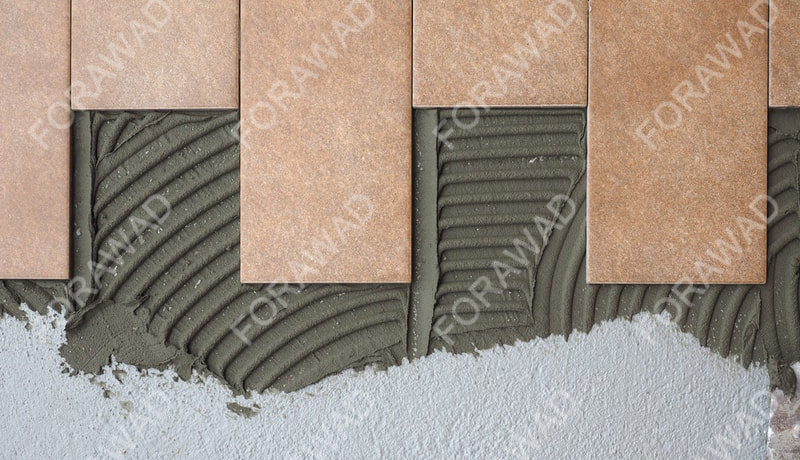
- What is RDP?
RDP is a powdered copolymer made from polymer emulsion through high-temperature spray drying. When it comes into contact with water, it can redisperse into a stable emulsion. After the water evaporates, it forms a polymer film in the mortar system, organically binding inorganic materials (such as cement and quartz sand) into a whole. FORWARD CHEM offers six standard RDPs (FWD 1100, FWD 1200, FWD 5044, FWD 5031, FWD 5010, FWD 5111), and FORWARD CHEM has adjusted and improved the corresponding performance of RDPs based on different applications.
- The Core Role of RDP in Tile Adhesive
In tile adhesive formulations, the addition amount of RDP is usually only 1.5%-5% of the total weight of the tile adhesive, but it brings about a leap in performance:
- Enhanced Bonding Strength and Cohesion
- Mechanical anchoring: The polymer film fills the pores of the cement hydration products, forming a dense structure.
- Chemical adsorption: The polymer molecular chains produce adsorption with cement minerals and the back of the tiles.
- Key improvement: Significantly improves the bonding strength with various substrates (concrete, plaster layers, old tiles) and low-water-absorption tiles (vitrified tiles, polished tiles, sintered stone), effectively preventing hollowing and detachment.
- Provides Flexibility and Stress Resistance
- The polymer film is elastic and can absorb and dissipate internal stresses caused by temperature differences, substrate creep, or slight vibrations, acting like "miniature springs."
- Significantly improves the lateral deformation capacity and impact resistance of tile adhesive, coping with the shaking of lightweight partition walls or the hot and cold cycles caused by underfloor heating.
- Improves Water Resistance
- The polymer film does not re-disperse in water, sealing the capillary pores of the mortar and preventing water penetration.
- Maintains high bonding strength even in long-term immersion environments, making it suitable for wet areas such as bathrooms and swimming pools.
- Improves Workability
- Acts as an air-entraining agent, making the mortar smoother, extending the open time (adjustment time) and setting time, giving workers more time for laying and adjusting tiles.
- Improves slip resistance, preventing tiles from sliding down even when laying large tiles or working from bottom to top.
III. Implications for Construction and Material Selection
- Do not arbitrarily add cement or sand to the tile adhesive.
- This will disrupt the precise ratio of RDP to other components in the formula, preventing the complete formation of the polymer film, leading to a sharp decline in performance and a significantly increased risk of hollowing and detachment.
- Select the appropriate grade of tile adhesive based on the application scenario.
- Indoor small floor tiles: C1 grade (ordinary type) tile adhesive can be used. For C1 grade tile adhesive, it is generally recommended to add1.5%-2% of rigid RDP1100/5010 and semi-flexibleFWD1200 . FWD1100/5010 enhances bonding strength and cohesion, while FWD1200 balances bonding strength and flexibility.
- Indoor wall vitrified tiles:C1E grade (enhanced type, slip-resistant) or higher should be used. For this type of tile adhesive, it is generally recommended to add 1.5%-3% FWD 5044.FWD5044 is a highly flexible RDP with strong flexibility and outstanding stress resistance, significantly improving the deformation resistance and impact resistance of the tile adhesive.
- Outdoor, underfloor heating, large format tiles (sintered stone): C2 grade (enhanced) or higher-grade flexible tile adhesive must be used. Flexibility and deformation resistance are key. For this type of tile adhesive, it is recommended to add ahigh proportion (more than 4%) of FWD5044, which can significantly improve the performance of the tile adhesive.
- Bathroom floor small tiles: A special C1 waterproof tile adhesive should be used. For this type of tile adhesive, it is generally recommended to add 1.5%-3% FWD 5031.FWD5031 is a special waterproof RDP. FWD enhances waterproof performance, has strong flexibility, and outstanding water resistance. Even in long-term immersion environments, it can maintain high bonding strength and waterproof effect.
- Emphasize Substrate Preparation
- RDP can improve bonding strength, but it cannot overcome problems such as loose or powdery substrates. A solid, clean, and level substrate is the first prerequisite for successful tile installation.
- Future Trends
As tile sizes become larger and materials become denser (such as sintered stone), the performance requirements for tile adhesives are becoming increasingly stringent. Future RDP and tile adhesive technologies will focus more on:
- Ultra-high performance: A combination of higher bonding strength and flexibility.
- Green and environmentally friendly: Reduced VOCs and the use of renewable raw materials.
- Optimized construction: A combination of longer open time and faster strength development.
Conclusion
Although RDP accounts for a small proportion in tile adhesives, it is the decisive component for achieving high strength, high flexibility, and high durability. It represents the wisdom of building materials science evolving from solely relying on inorganic cementing materials to organic-inorganic composite materials. Understanding the role of RDP can help professionals and consumers scientifically select and correctly use tile adhesives, fundamentally ensuring the long-term safety and aesthetics of tile installation projects.
[Contact Us] To request samples or speak with our technical experts about how FWDCEL RDP can transform your building materials. We also offer a range of RDP products in various specifications, widely used in diverse applications. Please feel free to inquire. For more information, please visit www.fwdnewtech.com or contact us at info@fwdnewtech.com. FORWARD CHEM– Your reliable partner in the field of construction chemicals.