
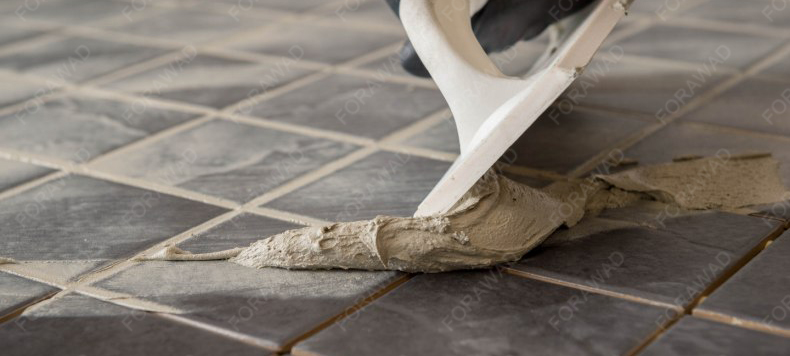
 In the tile laying system, although grout accounts for only a tiny volume, it undertakes multiple key functions such as sealing, waterproofing, mildew resistance, aesthetic enhancement, and stress buffering. The performance bottlenecks of traditional cement-based grout can no longer meet the stringent requirements of modern buildings for durability, health, and aesthetic effects. The emergence and popularization of redispersible polymer powder (RDP), especially the application of high-performance flexible RDP FWD 5044, marks a profound transformation of grout from a "filling material" to a "high-performance functional composite material". This article will explore the core application value of RDP, focusing on analyzing the action mechanism, applicable scenarios, and cutting-edge development trends of RDP FWD 5044.
- RDP FWD 5044: The "Chemical Engine" for Grout Flexibility Performance
RDP is a powder made from polymer emulsion through spray drying, which can be re-emulsified into a stable emulsion when exposed to water. Among them, as a vinyl acetate-ethylene copolymer powder, RDP FWD 5044, with its low glass transition temperature (Tg below 0°C) and excellent saponification resistance, has become the core modified component to solve the pain points of high-deformation scenarios in the hydration system of cement-based grout.
Dual Action Mechanism: Optimized Expression of Physical Reinforcement and Chemical Bonding
When the grout is mixed, RDP FWD 5044 particles quickly redisperse and evenly distribute between cement and aggregate particles. With the progress of cement hydration and the gradual evaporation of water, FWD 5044 particles agglomerate to form a continuous and highly flexible polymer film network, whose action mechanism is more targeted:
- Physical Toughening: The polymer film formed by FWD 5044 acts like "high-elasticity micro-ligaments". Relying on its excellent flexibility, it bridges microcracks and efficiently absorbs stress generated by temperature changes and substrate displacement (such as floor heating start-stop deformation). Compared with ordinary RDP, it can improve the flexural strength and deformation capacity of grout by more than 30%, fundamentally solving the cracking problem in high-stress scenarios.
- Chemical Bonding: This polymer film has super strong adhesion to hydrophilic inorganic substrates (cement paste, tile back) and hydrophobic tile glazes. Through the dual effects of physical anchoring and chemical bonding, it significantly improves the bonding strength. Combined with its saponification resistance, it can effectively avoid bonding failure and peeling in humid environments.
Specific Dimensions of Performance Improvement (FWD 5044 Enhanced Performance)
- Ultra-Low Water Absorption: The dense polymer film of FWD 5044 can block capillary pores, stably reducing the water absorption rate of the grout to below 3%, meeting the international standard for hydrophobic grout (CG2W), and providing core protection for impermeability, mildew resistance, freeze-thaw resistance, and alkali resistance.
- Excellent Durability: Low water absorption combined with saponification resistance can resist moisture, salt, daily stains, and chemical corrosion. In scenarios such as outdoors, swimming pools, and floor heating, it can extend the service life of grout to more than 1.5 times that of ordinary products.
- Superior Workability: The "ball bearing" effect of FWD 5044 is more significant, which can optimize the lubricity of the paste, making grouting smoother and more labor-saving. At the same time, its good water retention can prevent water from being absorbed too quickly by porous substrates, reserving sufficient time for full cement hydration and reducing construction error tolerance.
- High-Performance Formula Design: Scientific Adaptation of RDP FWD 5044
A high-performance grout formula with RDP as the core requires precise selection according to scenarios. RDP FWD 5044 has become the preferred choice for high-flexibility demand scenarios due to its unique performance:
Scientific Selection of RDP
- Mainstream Choice: Vinyl acetate-ethylene copolymer (EVA) RDP dominates the market with high cost-performance ratio. As a high-end flexible product in this category, RDP FWD 5044 balances cost-performance and adaptability to special scenarios.
- Waterproof Choice: Pure acrylic RDP FWD 5031 is suitable for extreme water immersion environments, while RDP FWD 5044, while taking into account weather resistance, focuses more on flexibility and deformation resistance, making it suitable for non-long-term water immersion but high-deformation demand scenarios such as floor heating, large-size panels, and curtain walls.
- Flexible Choice: As a benchmark product with low Tg (below 0°C), RDP FWD 5044 can endow grout with excellent deformation capacity. Its relatively high ethylene content further enhances flexibility, making it the core raw material for scenarios such as floor heating systems, large-size tile laying, and curtain wall grouting. Adding an appropriate amount of water repellent can further optimize alkali resistance.
III. Construction Practice: Maximizing the Efficacy of RDP FWD 5044
"Three parts material, seven parts construction" – the high performance of RDP FWD 5044 can only be fully exerted by standardized construction. The targeted construction points are as follows:
Core Construction Process Points (Adapted to FWD 5044 Characteristics)
- Joint Cleaning: The joints must be clean, dry, free of oil and loose materials, with uniform depth (3-5mm recommended), to avoid impurities affecting the combination of FWD 5044 polymer film and substrate.
- Mixing: Use an electronic scale to accurately control the water addition amount (22%-26% of the powder mass is recommended, adapted to FWD 5044 dispersion characteristics), stir thoroughly with a low-speed electric mixer until there is no dry powder, let it stand for curing (aging) for 2-3 minutes, then stir briefly again. Deviation in water addition will damage the formation of FWD 5044 polymer film, directly affecting flexibility and bonding strength.
- Grouting: Press the grout into the joints at a 45° angle along the diagonal direction to ensure no voids, and give full play to the stress buffering effect of FWD 5044.
- Cleaning: This is a key step determining the surface effect. After the grout initial sets and the surface begins to lose luster (usually 15-30 minutes after construction, depending on the environment), gently scrub the tile surface in a circular motion with a slightly damp fine-pored sponge or special cleaning cloth, and clean the sponge frequently. Avoid cleaning when the paste is too wet (which will cause material to be carried away) or scraping hard when it is too dry (which will damage the surface).
- Curing: Avoid water flushing, treading, and drastic temperature changes within 24-48 hours after construction (especially delayed heating for floor heating scenarios) to ensure the complete curing of FWD 5044 polymer film.
Common Problems and FWD 5044 Correlation Analysis
- Cracking: In addition to insufficient RDP addition and excessive cement content, cracking in floor heating scenarios is mostly related to insufficient RDP flexibility. Selecting FWD 5044 and controlling the dosage (2%-4% recommended) can effectively avoid this problem.
- Peeling: The main causes are unclean substrate, excessive water-cement ratio. Matching with FWD 5044 can improve bonding redundancy and reduce peeling risk, but construction details must be strictly controlled.
- Alkali Efflorescence: The dense film of FWD 5044 can inhibit alkali efflorescence. If it still occurs, check the water addition amount or use it with a water repellent.
- Future Outlook: RDP FWD 5044 and the Innovation Frontier of Grout
- Green Sustainability: Based on the existing copolymer system of RDP FWD 5044, develop bio-based raw material versions to reduce carbon footprint; optimize production processes to create low-dust products with recyclable packaging, in line with green building trends.
- Intelligence and Functionalization: Relying on the excellent matrix flexibility of FWD 5044, integrate self-healing microcapsule technology to achieve automatic healing of microcracks; develop composite formulas with both flexibility and thermal conductivity optimization for floor heating scenarios.
- Digitalization and Standardization: Optimize the performance stability of FWD 5044 through precise compounding technology, and combine with intelligent production lines to achieve accurate formula matching in different scenarios, promoting the industry to clarify RDP selection standards for high-deformation scenarios.
Conclusion
RDP has become the core component defining the performance level of grout. With the comprehensive advantages of low Tg flexibility, saponification resistance, and high bonding strength, RDP FWD 5044 has become the benchmark choice for high-deformation and high-durability demand scenarios. Through sophisticated physical toughening and chemical bonding effects, it transforms brittle cement matrix into flexible composite materials adapting to modern building needs, perfectly solving the cracking and peeling pain points in scenarios such as floor heating and large-size tile laying. For manufacturers, optimizing formulas with FWD 5044 as the core is the key to building differentiated competitiveness; for constructors, standardized use of high-performance grout containing FWD 5044 is a core investment to ensure long-term building quality. In the pursuit of excellent building performance, high-performance grout modified by RDP FWD 5044 will continue to guard the perfection and durability of every tile joint with innovative strength.